Showing posts with label ecosystems. Show all posts

Friday, June 15, 2012

Pineland Scrub Blossoms In Summer

Beauty in the white sands of a pine flatwoods and scrub ecosystem may be hard to imagine. Unknowing visitors will see the dead foliage, broken snags, and thick, impenetrable vegetation as weedy, unkempt, and dangerous, but native wildlife and naturalists appreciate the value of Florida's oldest ecosystem's resources to provide food, cover, and nesting during the summertime.

These dry, upland habitats were once Florida's ancient coasts but now are home for endemic species, both wildlife and vegetation that thrive in harsh environments with seasonal rainfall (both drought and flooding), nutrient deficiencies, and frequent fires.

My photographs of native plants and wildflowers were shot in a Seminole County ten-acre residential community that leaves all but the homesite undeveloped. Click on the photographs for larger viewing. The various pictures show berries for bears, birds, deer, gopher tortoises, and raccoons, and host plants for butterflies and birds.

Tarflower,Bejaria racemosa, Saw palmetto, Serenoa repens, Sparkleberry, Vacciunium arboreum. Mother Nature's Smorgasbord for Florida wildlife.

Blackroot, Pterocaulon pycnostachyum, provides food for wild hogs.

Coastalplain St. Johns-wort, Hypericum brachyphyllum, host plant for insect pollinators, like bees, butterflies, and moths. These flowers are found in bogs, lakefronts, coasts, and ephermeral ponds.

Frogfruit, Phyla nodiflora, Lippia nodiflora, can also be seen growing in urban cement sidewalk cracks, residential lawns, and near water. Host plant for the White Peacock Butterfly, Anartia jatrophae, Common Buckeye Butterfly, Junonia coenia, Phaon Crescent Butterfly, Phyciodes phaon.


Rusty Lyonia, Lyonia ferruginea, popular with deer and insects.

Saw palmetto, Serenoa repens, provides food for migrating mammals and birds, and is the host plant for the Palmetto Skipper.

Shiny blueberry, Vaccinium myrsinites, food resource for mammals, including humans, birds.

Tarflower, Bejaria racemosa, nectar plant for pollinators.

Six foot tall Tarflower, Bejaria racemosa

Wednesday, June 06, 2012

Restoring Ecosystems

Lakefront restoration is an effort that will restore or recreate an ecosystem of abundant natives on a residential or commercial shoreline.  Replacing the chemically-controlled non-native weeds that encroach and take over with appropriate wetland natives that keep weeds under control is not a cheap project but in the long run, will be more cost-effective and healthier for the environment than spraying chemicals regularly.  Native habitats also provide resources for food and nesting areas to attract more birds and wildlife.


Assess the lakefront site for surrounding ecosystems will help determine what native plants belong and if broadening the area to replant natives would be beneficial.


With my current landscape design project for a new home construction, the adjacent marsh area was seceding into an upland pine area because a small stream had been blocked by the previous owner's attempts to put a back entrance road into the property. In the future months, I am encouraging the new owners to unblock the stream and install a large cement drain pipe to allow water runoff from the road to flow down the hillside. As seasonal hurricane and summer rains begin, the stormwater runoff will enter into the marsh area, keeping the soils too wet for pines to establish.


Check out the before and installation photographs on my Facebook page.  I will post photographs of the lakefront after establishment.

Monday, February 07, 2011

What A Beautiful World We Live In

The beauty of our world is breathtaking and life-giving. We need to be good stewards of the gifts we have been entrusted.

Sunday, April 15, 2007

Planting Trees In Cooler Climates Could Be Hot Issue


National Academy of Sciences has published a study that makes note that planting trees in colder hemispheres could acerbate global warming. Researchers from Stanford University and Universite Montpellier II in France partnered with the Academy.

"Our study shows that only tropical rainforests are strongly beneficial in helping slow down global warming," Govindasamy Bala, an atmospheric scientist who led the research, said.

"It is a win-win situation in the tropics because trees in the tropics, in addition to absorbing carbon dioxide, promote convective clouds that help to cool the planet.

"In other locations, the warming from the albedo effect [sunlight absorption] either cancels or exceeds the net cooling from the other two effects."

[...] "When it comes to rehabilitating forests to fight global warming, carbon dioxide might be only half of the story; we also have to account for whether they help to reflect sunlight by producing clouds, or help to absorb it by shading snowy tundra," study co-author Ken Caldeira said.

However, the authors did not endorse deforestation of the boreal forests as a measure against global warming.

"Preservation of ecosystems is a primary goal of preventing global warming, and the destruction of ecosystems to prevent global warming would be a counterproductive and perverse strategy," Mr Caldeira said.

Makes sense to me. Allowing sunlight to filter through in the wintertime is why Mother Nature provides deciduous trees.

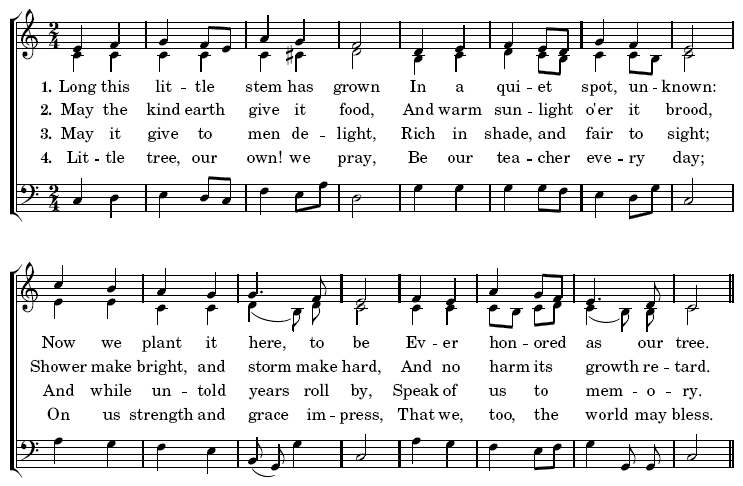
Do you want to sing a song while planting trees? Try this one.

Killer Trees?