Showing posts with label Global warming. Show all posts

Tuesday, October 12, 2010

Can Genetically Altered Plants Prevent Global Warming?


Could forests of genetically altered plants help sequester billions of carbon from the atmosphere annually and stave off global warming? That's the focus of research by Lawrence Berkeley National Laboratory and Oak Ridge National Laboratory scientists.

Besides increasing the efficiency of plants' absorption of light, researchers might be able to genetically alter plants so they send more carbon into their roots--where some may be converted into soil carbon and remain out of circulation for centuries. Other possibilities include altering plants so that they can better withstand the stresses of growing on marginal land, and so that they yield improved bioenergy and food crops. Such innovations might, in combination, boost substantially the amount of carbon that vegetation naturally extracts from air, according to the authors' estimates.
Read more here.

Thursday, October 07, 2010

Bee Colony Collapse Disorder Solved?


In a collaborative effort between scientists and military, the mystery behind what is killing honeybee colonies throughout the United States and Europe may be solved. Since 2006, over a third of the managed honeybee colonies in the United States have disappeared. One of the difficulties in determining what was causing the mass death of millions of honeybees was that scientists could not perform autopsies on bees. Once afflicted the bees don't die immediately but fly away from their hive and die. Causes of the high death rate have been blamed on everything from cellphones, global warming, mites, pollution, pesticides, to genetically modified food. Fortunately a cure may not be far off.
A fungus tag-teaming with a virus have apparently interacted to cause the problem, according to a paper by Army scientists in Maryland and bee experts in Montana in the online science journal PLoS One.

Exactly how that combination kills bees remains uncertain, the scientists said — a subject for the next round of research. But there are solid clues: both the virus and the fungus proliferate in cool, damp weather, and both do their dirty work in the bee gut, suggesting that insect nutrition is somehow compromised.

Read more about the unique technology that a brother tag-team and Army specialists combined to find the facts behind Honeybee Colony Collapse disorder.

Tuesday, April 27, 2010

Earth Day News: CO2 Isn't Harmful To Environment

More science based data on CO2's harmful effects: There's none.

CO2SCIENCE: Isolated for 42 days in chambers of ambient and elevated CO2 concentrations, we periodically document the growth of cowpea plants (Vigna unguiculata) via time-lapse photography.


Wednesday, January 06, 2010

UK Experiencing Heaviest Snowfall In Fifty Years


The little island empire of England and Scotland, protected by the warm Gulf Stream, seems to be out of touch with the ICCP's prediction of global climate change. The Met Office for weather issued emergency warnings for the kingdom:

Forecasters predicted that more than one foot of snow could fall in less than 24 hours in most southern areas leading to widespread chaos and disruption for millions.

The residents of Hampshire and Wiltshire were expected to be the worst hit, with as much as 16 inches likely to be dumped by the end of tomorrow. Residents and commuters in London, which ground to a halt last February following heavy falls, were warned to expect a covering of several inches by the morning rush hour.

On the roads drivers were advised not to venture out unless their journey was absolutely essential, as councils warned they could run out of grit if the conditions failed to improve.

The Met Office claimed the amount of snow forecast could be the biggest single fall since the notorious winter of 1962-63, when some areas of the country were blighted by snow and ice for more than three months.

These photos are from my sister's home in Berwick St. James outside of Wiltshire, the region expected to be one of the hardest hit. Fortunate she is a champion dog breeder and trainer, because they will definitely be experiencing a cuddly three dog night.


Monday, June 08, 2009

Global Warming?


Check out Watts Up With That? Anthony Watts' blog on puzzling things in life, nature, science, weather, climate change, technology, and recent news.
Tip of the snow shovel to Bob!

Sunday, June 10, 2007

North America Facing Worst Drought In History

A British newspaper, The Independent, reporting that America is facing it's worst drought in history, worse than the Dust Bowl years during the late 1920's.

From the mountains and desert of the West, now into an eighth consecutive dry year, to the wheat farms of Alabama, where crops are failing because of rainfall levels 12 inches lower than usual, to the vast soupy expanse of Lake Okeechobee in southern Florida, which has become so dry it actually caught fire a couple of weeks ago, a continent is crying out for water.

In the south-east, usually a lush, humid region, it is the driest few months since records began in 1895. California and Nevada, where burgeoning population centres co-exist with an often harsh, barren landscape, have seen less rain over the past year than at any time since 1924. The Sierra Nevada range, which straddles the two states, received only 27 per cent of its usual snowfall in winter, with immediate knock-on effects on water supplies for the populations of Las Vegas and Los Angeles.

The human impact, for the moment, has been limited, certainly nothing compared to the great westward migration of Okies in the 1930 - the desperate march described by John Steinbeck in The Grapes of Wrath.

Big farmers are now well protected by government subsidies and emergency funds, and small farmers, some of whom are indeed struggling, have been slowly moving off the land for decades anyway. The most common inconvenience, for the moment, are restrictions on hosepipes and garden sprinklers in eastern cities.

But the long-term implications are escaping nobody.

Meanwhile, China is flooding - Millions suffering.

Wednesday, June 06, 2007

Surge Or Not To Surge?

Still more controversial studies on global warming increasing hurricanes.
A surge in major Atlantic hurricanes over the last decade -- often cited as evidence of increasing global warming -- may not be a surge at all but a return to normal storm patterns, according to a new study.

Using nearly three centuries of hurricane history recorded in organic storm debris encased in coral reefs, researchers found that the frequency of major hurricanes today was about the same as it was during extended periods from the mid-1700s to the mid-1900s.

"There were periods that were just as active as we see now," said study coauthor Terrence Quinn, a paleoclimatologist at the University of Texas at Austin.

At the same time, the researchers found that the number of major hurricanes from the late 1960s to the early 1990s -- a period that our present cycle is often compared to -- was unusually quiet for storms.

Saturday, April 28, 2007

Ancient Rainforest Found In Coal Mine

What comes to mind when you hear the word rainforest?

Do you picture South America, Africa, Australia, Asia, the Amazon, lots of humidity, wetlands, ferns, tropical plants, tropical wildlife species, and huge trees?

But would the location of Danville, Illinois come to mind?

It's amazing to me how much the earth has changed over the last few million years. Now more fern fossils found confirm that Illinois used to be the site of an ancient rainforest. Check out Live Science's article.

Sunday, April 15, 2007

Planting Trees In Cooler Climates Could Be Hot Issue


National Academy of Sciences has published a study that makes note that planting trees in colder hemispheres could acerbate global warming. Researchers from Stanford University and Universite Montpellier II in France partnered with the Academy.

"Our study shows that only tropical rainforests are strongly beneficial in helping slow down global warming," Govindasamy Bala, an atmospheric scientist who led the research, said.

"It is a win-win situation in the tropics because trees in the tropics, in addition to absorbing carbon dioxide, promote convective clouds that help to cool the planet.

"In other locations, the warming from the albedo effect [sunlight absorption] either cancels or exceeds the net cooling from the other two effects."

[...] "When it comes to rehabilitating forests to fight global warming, carbon dioxide might be only half of the story; we also have to account for whether they help to reflect sunlight by producing clouds, or help to absorb it by shading snowy tundra," study co-author Ken Caldeira said.

However, the authors did not endorse deforestation of the boreal forests as a measure against global warming.

"Preservation of ecosystems is a primary goal of preventing global warming, and the destruction of ecosystems to prevent global warming would be a counterproductive and perverse strategy," Mr Caldeira said.

Makes sense to me. Allowing sunlight to filter through in the wintertime is why Mother Nature provides deciduous trees.

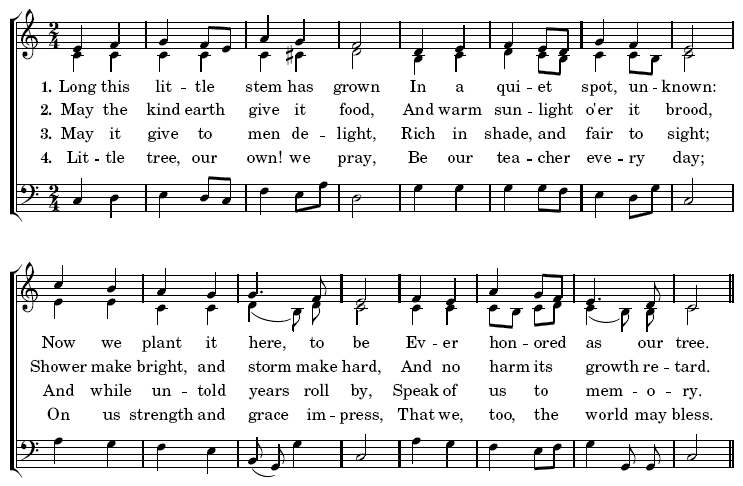
Do you want to sing a song while planting trees? Try this one.

Killer Trees?